
Something I've often thought about as a 3D character artist is how much things change and paradoxically, how much they also stay the same. The last couple of years have brought massive change to the art industry of film and video games. I won't belabor the point of just how many seismic shifts there have been in 2025 alone.

Yet despite it all, there are some things that stay the same. Death. Taxes. And... the essential importance of the skull for anyone that wants to depict humans!
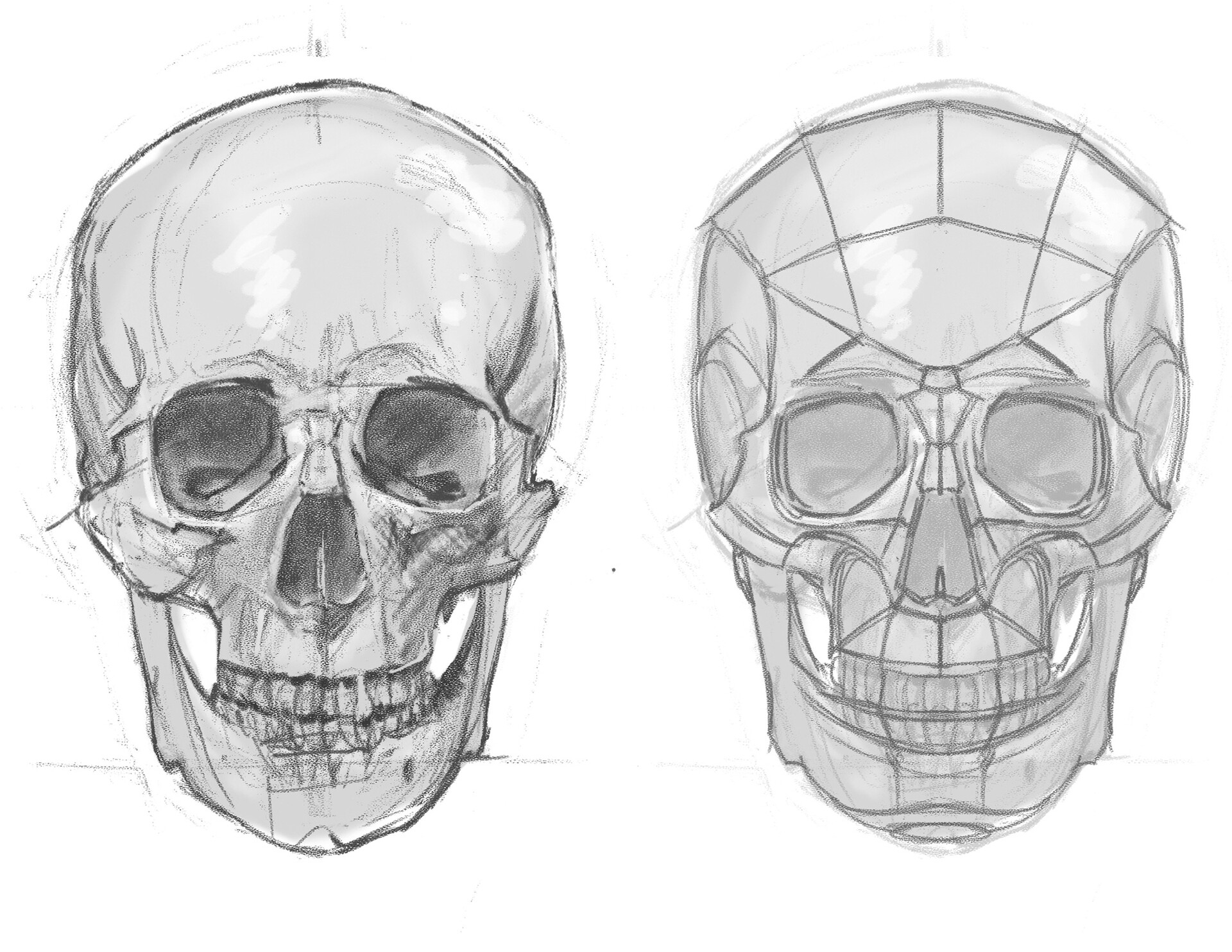
The skull is so critical to rendering faces and heads that we tend to forget its paramount importance. Think of these posts as a helpful reminder for getting back in touch with this foundational structure. We all want shortcuts to greatness. There's so much we all have to do these days... 3D artists are always looking for things we can skip - the interior faces of a shirt, the bottom of a boot, etc. The skull seems like you could just skip it. After all, we never see it, right?


Actually we literally see the skull, all the time. Let's take a very typical problem for the 3D character artist: understanding the shape of a person's head underneath their hair. In every production, hair is a separate asset from the head. We tend to conflate hair with the form of the head. When you imagine a woman's face, hair is always part of the picture. Bald women are relatively rare, so they don't appear in our mental lexicon. But when modeling a female character, it is the first thing you have to confront: what is the shape of this person's head, underneath their hair?


If you haven't studied the skull and have tried to sculpt a woman's bald head, then you know precisely what I am talking about.
This is just one reason to learn all you can about the skull. It is also the basis for all other subsequent forms that layer on top: muscle, fat, skin, and a couple of glands. Throughout my art school experience, I was often lectured about "bony landmarks." These are covered in a ton of other literature... and while they are useful in some ways, they can be deceptive in their over-simplification. Every time I heard the phrase, "bony landmark," I made the deduction that this was the only part of the skull that mattered. So... forehead, nose bridge, temple, cheekbone, maybe the chin and the jawline... that's it, right?


Wrong! Every part of the skull is a kind of landmark, they are just differentiated by relative depth to the surface. When I was a student, no one ever told me that teeth were a bony landmark. But teeth are pretty important. They are more "landmarky" that anything else because when you open your mouth, your teeth are the most visible aspect of the skull. The curvature of the teeth contributes massively to the curvature of the muzzle and lips. But so often, we artists gloss over this detail. We draw and sculpt faces when the mouth is conveniently closed... and we forget about how important the teeth are. It creates a blind spot and makes lips that much harder to really get right.

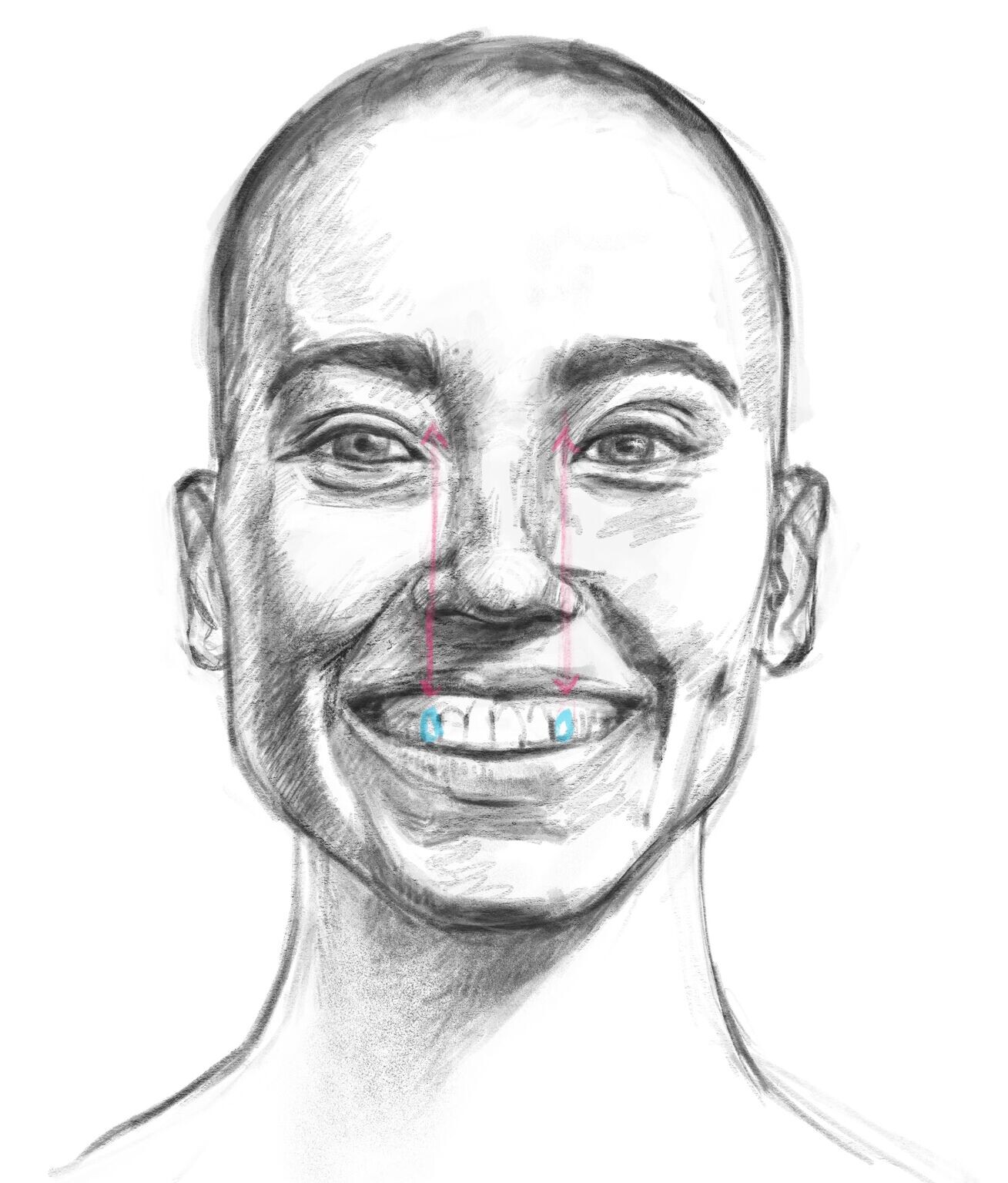

There is even a magic tooth - the canine tooth - that we as artists can use to great effectiveness. The wonderful thing about the canine tooth is that it typically lines up with the medial edge of the orbital cavity of the eye. This little border delineation means you can pretty easily judge where the inner eye should be, as well as the side plane of the nose, all from the canine tooth.

Let's talk about another part of the skull that isn't considered a "bony landmark": the rear of the jaw. This part of the jaw is layered with a muscle near the back called the masseter. On top of that is fat, skin and even a gland (the parotid gland). It's positively buried. Not important, right?
Wrong! (You probably saw that one coming). When we open our mouths, the rear of the jaw affects everything. It lengthens the appearance of the front plane of the face. It not only acts like a hinge for the mandible, it also slips forward slightly during articulation, making jaw opening a surprisingly complex movement. It can even move side to side, so it arguably has three axes of movement. If your character has to talk (and many do), you'd better understand what's going on with the rear of the jaw - this "non-bony landmark."
So how do we deal with the skull if every part of it is important? This is where building your own blockout skull comes into play. The process teaches every part of the skull - nothing glossed over, but with intricate forms simplified into basic planes so that we can use them effectively as mental models. In part 2 of this blog post series, I'll dive into this matter and hopefully we all can have a bit more appreciation for this amazing configuration of bones. After all, it holds all the good stuff that makes us so very human.